Be yourself; Everyone else is already taken.
— Oscar Wilde.
This is the first post on my new blog. I’m just getting this new blog going, so stay tuned for more. Subscribe below to get notified when I post new updates.
Be yourself; Everyone else is already taken.
— Oscar Wilde.
This is the first post on my new blog. I’m just getting this new blog going, so stay tuned for more. Subscribe below to get notified when I post new updates.
“Young” is often an adjective attached with our country crediting to the fact that India has the largest youth population in the world. This very title is in danger as we are on the path to become the most populous country and overtime this young India will have to get old. The government of India has recently stated that India will have 34 crore people above 60 years of age by 2050 which would be more than the total population of the US. In such cases, the country loses its demographic divide and points to a situation where in a large portion of the economy is dependant on the working population. The two problems of rising population and high dependency rates only add to the issues of providing jobs, education, health care etc.
In a recent report released by SBI, it stated that India only has a window of 10 years to grow enough to be get under the developed country tag, or remain in the group of emerging economies. The report warned that “India’s strength of demographic dividend could actually turn into India’s disadvantage by 2030”. When populations age with a rapid growth, the consequences are often met with unprepared and under planned governments which has direct implications to the socio-economic status and the health status of the elderly.
Three key demographic changes—declining fertility, reduction in mortality and increasing survival at older ages—contribute to population ageing. The demographic transition process of declining fertility and mortality gives rise to increasing gap between the young generation and the < 60 age group.
Around the world, 11.5% of the total global population of 7 billion is formed of the 60+ population and the UN estimates the figure to go up to 22% when the elderly population will outnumber the total children (below 15yrs).
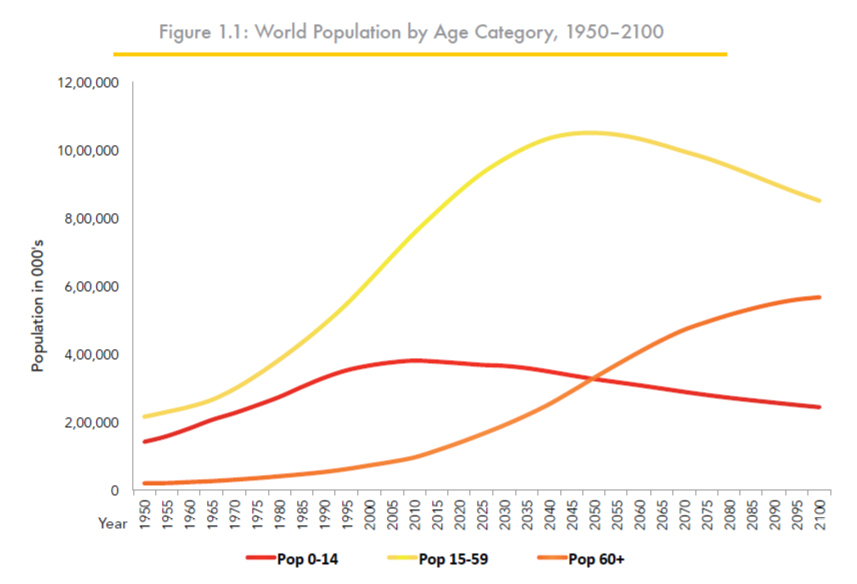
Source: United Nations (2015), World Population Prospects Report
The percentage of elderly people in India has increased at an increasing rate in recent years and the trend is likely to continue in the coming decades. The proportion of the population over 60 years of age is projected to increase from 8% in 2015 to 19% in 2050 [figure 1.1]. By the end of the century, the elderly will constitute about 34% of the total population of the country.
It is therefore clear that the relatively young India will shift into a rapidly aging society in the years to come. A notable characteristic of an aged population in India is the interstate disparity in terms of different levels and growth of the elderly population depending upon the demographic transition and factors such as health care prevailing in these states.
India has significant demographic diversity mostly based off the stage of transition between the youth and the elderly and variations in the death rate and fertility rates. The pattern observed in the country is such that the southern states are the front runners in population aging along with Himachal Pradesh and Maharashtra. The northern states of Uttar Pradesh, Rajasthan, Madhya Pradesh have considerably lower proportions of aged population [figure 1.4]
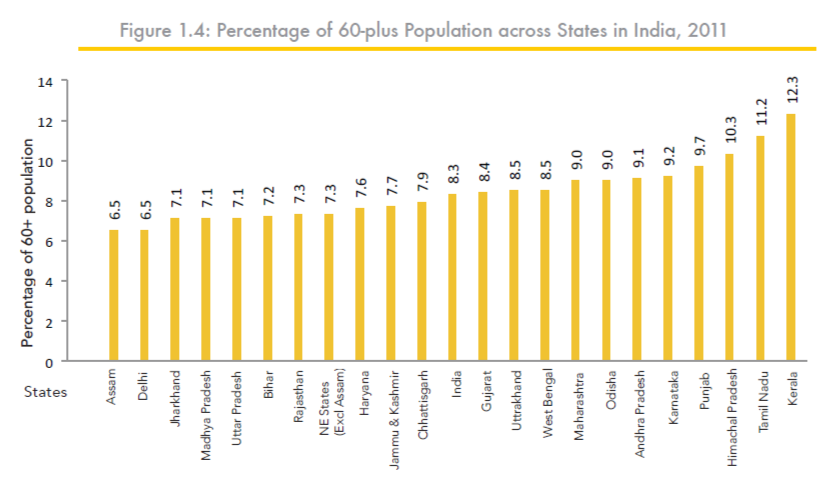
Source: ORGI (2011), Census of India
In states such as Kerala, Goa, Punjab the observed dependency is higher than 15% whereas it is lower in the North-eastern states. From the graph above and the dependency ratios, we can say that the states with higher proportions of aged populations have higher dependency ratio observed among the elderly whereas in case of lower aged populations the dependency ratio is also lower. Higher old-age dependency results into higher level of demand for care from immediate family. In most states the life expectancy has seen substantial improvement in the past years. The life expectancy observed in women is higher than men in case of all states.
Challenges of an aging population
The sex ratio has seen a tremendous shift in the past 40 years, from 938 women to per 1000 males in 1971 among the 60+ population to 1033 women per 1000 males in 2011 and is estimated to rise to 1060 by 2026. Such feminisation leads to discrimination and neglect faced by the aged women, this happens due to the higher dependency old women have on their children.
According to the 2011 census, 71% of the aged population resides in rural India. The rural aged population faces higher consequences in terms of income insecurity, lack of access to medical care and isolation compared to the urban aged group.
Projections indicate that during 2000–2050, the overall population of India will grow by 56% while the population 60-plus will grow by 326%. During the same period, the 80+ population will see a 700% increase with a predominance of widowed and highly dependent very old women. This specific population needs special care in terms of policies and programmes as they have greater dependency implications.
Migration of the younger working population has social effects such as social isolation, poverty and emotional distress. However, older people prefer to survive in their familiar communities, this puts more funds in the elder’s hands which makes them more financially independent.
Economic implications of Increasing aged population
An economy majorly composed of senior citizens has different drivers of demand than an economy with higher birth rates. An increasingly aging population tends to have greater demand for quality health care and post-retirement services. In such cases, the economies may face challenges shifting towards a consumer base increasingly driven by services for the aged populations. An increased old age population will have the following economic implications –
India is on the path to have a tremendous aged population which means the gap between the retired population and the 0-15 yrs age group is going to keep on widening which means there will be fewer working age people in the economy. This will lead to a massive shortage in the supply of qualified workers resulting in business operations finding difficulty filling jobs. Such an economy which faces lower labour demand will have adverse consequences in declining productivity, increased labour costs, slower economic growth and reduced international competition.
A labour shortage will push up wages causing wage inflation and create the vicious cycle of wage-price spiral.
To fill the demand for high skill requirement jobs many economies look towards immigration attracting highly skilled immigrants to fill the void.
A country with increasing aged population also experiences increased demand for health care therefore economies must allocate more money to the medical sector. The health care expenditure is already a major proportion of the GDP in most advanced economies so increasing expenditure in this sector will pose difficulty all the while ensuring that the quality of present systems improve more importantly in the public sector. This will require huge investments from the governments side. The problems faced by the Indian health care systems include shortage of highly skilled professionals and the use of outdated technology. All of these cost escalators pose problems for established systems to manage the prevalence of chronic illnesses more frequently seen among the aged people.
An increased expenditure on health care systems create a “debt-time bomb” i.e when the economy funds its increased expenditure by way of public borrowings. This was seen in the U.K in 2014 when 50% of the government expenditure was completely compose of social benefits and publicly funded health systems. This was a major fiscal challenge faced by the British administration as due to the increased expenditure the population of 85+ population saw a significant rise and this population group requires more provisions in terms of medical care and community services than those aged 65-74.
Although it is difficult to estimate the effect of an ageing population on the tax yields due to many unpredictable variables, an increased non-working population requiring support from the state will have some contribution in determining the tax imposed on working population. In a study conducted in the U.K, it was observed that in 2008, for every pensioner there were 3.2 people of working age contributing but now it is projected to fall to 2.6 by 2030. The cause for this drop can be directly credited to the increased life expectancy and lower death rates.
Dependency ratio is the proportion of people who work to those who don’t. If the retirement age of 60-65 does not change and the life expectancy keeps on increasing there will basically be more people living off of the benefits and fewer people working and paying taxes.
Increasing life expectancy will have a tendency on people to start saving more and putting a higher percentage of their income into pension funds. This could reduce the income available for capital investment which can have larger implications on the economy as a whole in terms of lower economic growth.
Policy Response to Ageing in India
The Indian government’s commitment to this problem of increasing old age population is evident in two important ways –
“The National Policy on Older Persons (NPOP), 1999 envisages State support to ensure financial and food security, health care, shelter and other needs of older persons, equitable share in development, protection against abuse and exploitation, and availability of services to improve the quality of their lives.” (Government of India, Ministry of Social Justice and Empowerment, 2017)
Policy Recommendations to curb the over-population of old-age persons –
The retirement age observed and accepted in India is 60-65 yrs. A large portion of the rural population continues working even after this age, so making it easier for people to continue working will help in reducing dependency rate and it will contribute to the economy’s growth.
When the population shifts from a larger working force to retired population, a shortage of labour supply is created so employment of highly skilled immigrants helps in employment.
Conclusion
India is on the path to come the most populated country in the world and in a few decades the population is estimated to have close to 20% of the population over the age of 65, such a large proportion of non-working population can have drastic implications on the economy such as high dependency rates, public debts, increased public health expenditure. It is extremely crucial for the Indian government to consider this issue of paramount importance and implement policies with regard to this problem.
References
India Ageing Report. (2017).
Retrieved from: https://india.unfpa.org/sites/default/files/pub-pdf/India Ageing Report – 2017 (Final Version).pdf
Demographic time bomb: Young India ageing much faster than expected. (2018, August 13).
The Ageing Population. (n.d.).
Retrieved from: https://www.economicsonline.co.uk/Global_economics/The_ageing_population.html
Faruqee, H. (2002, January). Population Ageing and its Macroeconomic Implications. Retrieved from https://www.imf.org/external/pubs/ft/wp/2002/wp0216.pdf
How Does an Aging Population Affect a Country? (2016, September 1).
Retrieved from https://www.worldbank.org/en/news/feature/2016/09/05/uruguay-como-afecta-pais-envejecimiento-poblacion
Nagarajan, N. R., & Teixeira, A. (n.d.). The impact of an ageing population on economic growth: An exploratory review of the main mechanisms.
Retrieved from:
https://www.jstor.org/stable/pdf/43755167.pdf?refreqid=excelsior:92dd07327956dacbacc468feb90fb2cc
This is an example post, originally published as part of Blogging University. Enroll in one of our ten programs, and start your blog right.
You’re going to publish a post today. Don’t worry about how your blog looks. Don’t worry if you haven’t given it a name yet, or you’re feeling overwhelmed. Just click the “New Post” button, and tell us why you’re here.
Why do this?
The post can be short or long, a personal intro to your life or a bloggy mission statement, a manifesto for the future or a simple outline of your the types of things you hope to publish.
To help you get started, here are a few questions:
You’re not locked into any of this; one of the wonderful things about blogs is how they constantly evolve as we learn, grow, and interact with one another — but it’s good to know where and why you started, and articulating your goals may just give you a few other post ideas.
Can’t think how to get started? Just write the first thing that pops into your head. Anne Lamott, author of a book on writing we love, says that you need to give yourself permission to write a “crappy first draft”. Anne makes a great point — just start writing, and worry about editing it later.
When you’re ready to publish, give your post three to five tags that describe your blog’s focus — writing, photography, fiction, parenting, food, cars, movies, sports, whatever. These tags will help others who care about your topics find you in the Reader. Make sure one of the tags is “zerotohero,” so other new bloggers can find you, too.

 Eco-Logical